
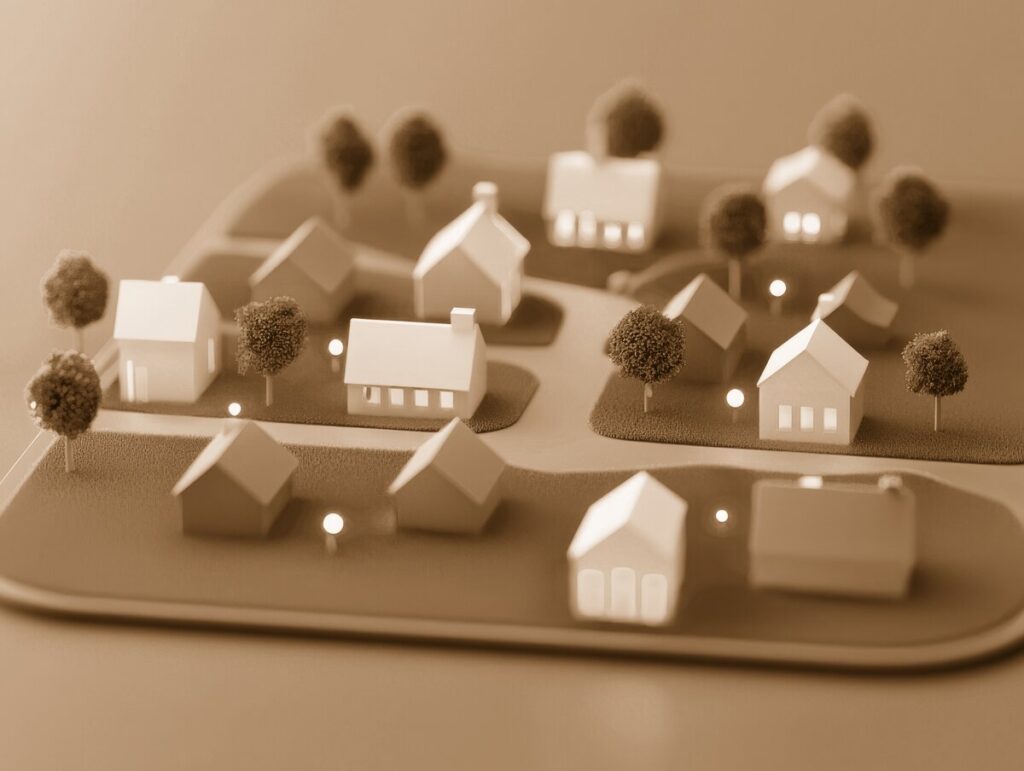
A Quiet Corner with a Long Story
Bayberry is one of those New Rochelle neighborhoods that reveals itself gradually. There is no grand commercial avenue announcing its arrival, and no single monument that tells its whole story. Instead, Bayberry is experienced through winding residential streets, mature trees, tucked-away homes, neighborhood traditions, and the familiar feeling that people have looked after this place for generations.
Located in the northern part of New Rochelle, Bayberry is generally associated with Bayberry Lane, Pine Park Drive, Woodhollow Lane, Highridge Road, Old Country Road, Split Rock Lane, Woodcut Lane, Stony Run, and Hunt Path. The neighborhood sits near New Rochelle High School and the Henry Barnard Early Childhood Center, placing it within a part of the city where residential life and public institutions have long grown alongside one another. ([learnsth.icu](https://learnsth.icu/wiki/List_of_New_Rochelle_neighborhoods?utm_source=openai))
Like much of northern New Rochelle, Bayberry carries the imprint of the city’s earlier rural landscape. Before the area became a settled residential subdivision, this part of Westchester was a patchwork of farms, wooded tracts, stone walls, lanes, and country properties. New Rochelle itself began as a Huguenot settlement in the late seventeenth century, and its northern reaches remained comparatively open well into the twentieth century. Over time, farms and estates gave way to streets and homes, but the land’s older character never disappeared completely.
How Bayberry Got Its Name
The neighborhood’s name is commonly understood to come from the bayberry shrub, a hardy native plant associated with coastal New England and the Mid-Atlantic landscape. Bayberries thrive in sandy or well-drained soil and were traditionally valued for their fragrant wax, which was used to make candles.
There does not appear to be a single surviving document that definitively records the exact moment the name “Bayberry” was chosen. That uncertainty is part of the neighborhood’s charm. The name fits the setting: natural, understated, and rooted in the vegetation and terrain that preceded the houses. As residential development took shape, “Bayberry” became a way to identify not only a street but a distinct community.
The name also reflects a broader tradition in New Rochelle. Many local neighborhoods—Beechmont, Pinebrook, Rochelle Park, Forest Heights, and others—draw their identities from landscape, trees, estates, or planned residential development. Bayberry belongs to that same family of place names, where the natural world remains present in the vocabulary of everyday life.
From Country Land to Residential Neighborhood
Bayberry’s major transformation came during the era when New Rochelle expanded northward and suburban homebuilding accelerated. The city had already developed a reputation as a desirable residential community by the late nineteenth and early twentieth centuries. Planned neighborhoods such as Rochelle Park helped establish New Rochelle as a center of suburban design, eventually contributing to the city’s nickname, the “City of Homes.” ([en.wikipedia.org](https://en.wikipedia.org/wiki/New_Rochelle%2C_New_York?utm_source=openai))
Bayberry developed later and in a different style. Rather than the formal, landscaped residential park model associated with Rochelle Park, Bayberry is more informal and family-oriented. Its roads follow the contours of the land, and its homes generally sit within a leafy setting that feels removed from the busier parts of the city.
The neighborhood’s growth reflected several wider changes:
- The expansion of automobile travel made northern New Rochelle more accessible to commuters.
- Postwar demand encouraged the conversion of large parcels and former country properties into residential streets.
- New Rochelle’s public-school system helped make the area attractive to families.
- Neighborhood associations and informal social networks gave the community an identity beyond its housing stock.
By the second half of the twentieth century, Bayberry had become an established residential community rather than a newly developing subdivision. Many homes built during the neighborhood’s formative decades have since been renovated, expanded, or carefully maintained, creating a streetscape that combines mid-century suburban design with later improvements.
Community Life and the Bayberry Tradition
One of Bayberry’s most important historical assets is not a building but its tradition of organized community life. A 1989 Bayberry community bulletin described a neighborhood summer camp, a local newspaper, private school-bus arrangements, and regular social events. It also emphasized how children moved through the New Rochelle school system alongside familiar groups of Bayberry friends. ([bayberryhome.org](https://bayberryhome.org/wp-content/uploads/2021/04/bulletin_1989.pdf?utm_source=openai))
That snapshot offers a valuable glimpse into the neighborhood’s character. Bayberry was not simply a collection of houses; it was a place where families recognized one another, shared responsibilities, and created traditions for children. Community life often centered on ordinary but meaningful activities—summer gatherings, seasonal celebrations, pool days, neighborhood announcements, and informal play.
The neighborhood’s pool and clubhouse have served as especially recognizable gathering places. They represent a kind of community institution that is easy to overlook in formal histories but central to residents’ memories. For many families, a neighborhood pool is where friendships begin, older residents stay connected, and successive generations develop a shared sense of belonging.
Schools, Streets, and Nearby Landmarks
Although Bayberry has few officially designated historic landmarks of its own, several nearby institutions help place it within New Rochelle’s larger story.
New Rochelle High School stands near the neighborhood and has long been an important civic presence. The school’s location connects Bayberry to generations of students, teachers, athletic teams, performances, and public events. The Henry Barnard Early Childhood Center also serves families in the area and reinforces Bayberry’s identity as a neighborhood closely tied to education. ([learnsth.icu](https://learnsth.icu/wiki/List_of_New_Rochelle_neighborhoods?utm_source=openai))
The surrounding northern New Rochelle landscape provides additional context. Nearby neighborhoods such as Wykagyl, Pinebrook, Bonnie Crest, and Ward Acres preserve traces of the city’s transition from rural land to residential suburb. Ward Acres, in particular, offers a reminder of the region’s former estate and agricultural character through its open landscapes, trees, and preserved natural areas.
Even the street names tell a story. Bayberry Lane evokes native vegetation; Pine Park Drive suggests wooded ground; Woodhollow Lane, Woodcut Lane, and Stony Run recall topography and natural features. Together, these names preserve a faint record of the land as it may have appeared before subdivision.
Bayberry Today
Today, Bayberry remains one of New Rochelle’s quieter residential communities, but it is not frozen in the past. Houses have changed hands, families have arrived from many backgrounds, and older properties have been modernized to meet contemporary needs. Landscaping has matured, architectural styles have been updated, and the neighborhood has adapted to changing patterns of work, school, and family life.
What has endured is the balance between privacy and connection. Bayberry offers the feeling of a wooded retreat while remaining close to New Rochelle’s schools, shopping areas, transportation routes, and downtown. Its winding streets encourage a slower pace, yet the neighborhood remains part of a diverse and active city.
For longtime residents, Bayberry’s heritage lives in accumulated memories: children walking to a friend’s house, neighbors gathering at the pool, families returning year after year, and familiar trees standing through decades of change. Its history is not concentrated in one famous structure. It is written across the landscape—in the roads, the homes, the institutions nearby, and the relationships that have made the neighborhood feel like home.
That may be Bayberry’s greatest distinction. It is a community whose heritage is experienced rather than displayed: quietly, naturally, and one generation at a time.